How Many Study Subjects Do You Really Need? A Practical Guide to Sample Size Calculation
- Abdelrahman Zamzam

- 23 hours ago
- 5 min read
One of the first questions every researcher asks when planning a study is:
"How many study subjects do I need?"
The answer is rarely as simple as "the more, the better."
Choosing an appropriate sample size is one of the most important decisions in study design. Whether you are conducting a randomized controlled trial, cohort study, case-control study, cross-sectional survey, or another type of research, the sample size directly influences the quality, reliability, and credibility of your findings.
A study with too few subjects may fail to detect an important effect, while a study with too many subjects may waste valuable time, money, and resources. Finding the right balance is essential.
What Is Sample Size?
Sample size refers to the number of study subjects included in a research study.
The goal is not to recruit as many subjects as possible. Instead, the goal is to recruit enough subjects to answer the research question with an acceptable level of statistical certainty while avoiding unnecessary recruitment.
An appropriately calculated sample size helps ensure that study conclusions are both scientifically valid and ethically justified.
Why Is Sample Size So Important?
Sample size affects almost every aspect of a study.
An appropriate sample size can:
Improve the reliability of the study findings.
Increase the likelihood of detecting a true effect when one exists.
Produce more precise estimates with narrower confidence intervals.
Reduce the risk of misleading conclusions.
Support ethical and efficient use of research resources.
In contrast, an inappropriate sample size can seriously weaken an otherwise well-designed study.
What Happens If the Sample Size Is Too Small?
Small studies are often described as underpowered.
Even if a treatment truly works or an important association exists, an underpowered study may fail to detect it simply because too few subjects were included.
This may lead researchers to incorrectly conclude that there is no effect when, in reality, the study did not have enough information to demonstrate one.
Small studies also tend to produce less precise estimates and wider confidence intervals, making the results more uncertain.
What Happens If the Sample Size Is Too Large?
Many researchers assume that recruiting more subjects is always better.
Not necessarily.
Very large studies require more funding, more time, more personnel, and greater logistical effort. They may also expose additional subjects to study procedures without providing meaningful scientific benefit.
Large studies can also detect extremely small differences that are statistically significant but clinically unimportant.
The objective is not to maximize the sample size—it is to determine the appropriate sample size.
Sample Size Is Important for More Than Clinical Trials
Sample size calculation is often associated with randomized controlled trials, but it is equally important in many other types of research.
Examples include:
Randomized controlled trials (RCTs)
Cohort studies
Case-control studies
Cross-sectional studies
Diagnostic accuracy studies
Surveys and prevalence studies
Laboratory and experimental research
Although the statistical methods differ, every study design requires thoughtful planning to ensure that the sample size is appropriate for the research question.
What Information Is Needed to Calculate Sample Size?
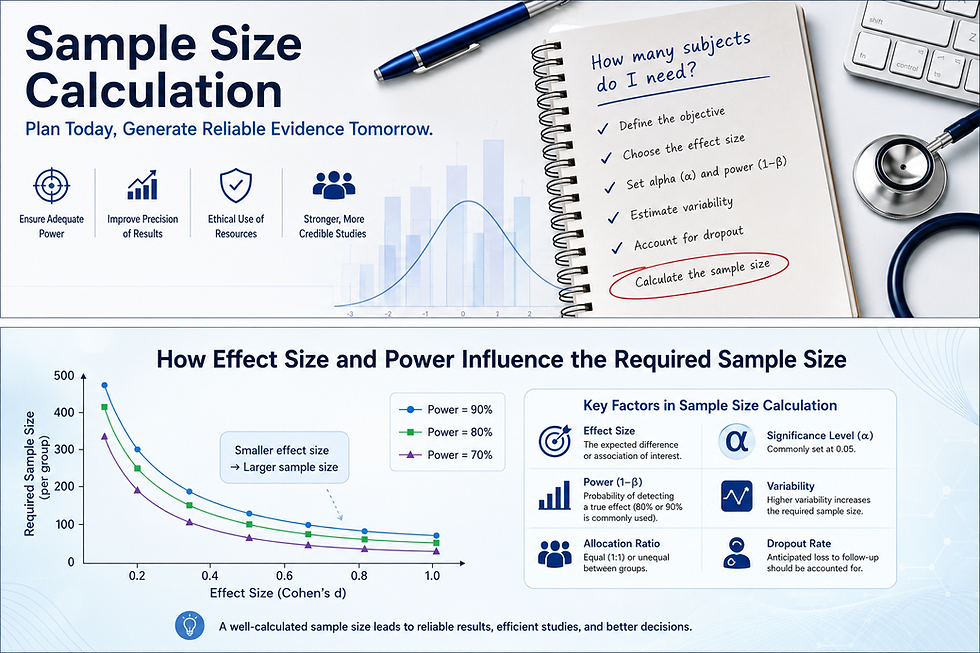
Several factors influence the required sample size.
1. Significance Level (Alpha)
The significance level, often set at 0.05, represents the threshold used to evaluate statistical evidence against the null hypothesis.
A smaller alpha generally requires a larger sample size.
2. Statistical Power
Power is the probability of detecting a true effect if one actually exists.
Many medical studies use 80% power, while some regulatory or confirmatory studies use 90% power.
Higher statistical power usually requires more study subjects.
3. Effect Size
The expected effect size is one of the most influential components of sample size calculation.
In general:
Smaller expected effects require larger sample sizes.
Larger expected effects require smaller sample sizes.
Choosing a realistic effect size is therefore critical.
4. Variability
Studies with greater variability require more subjects to estimate effects precisely.
For continuous outcomes, higher standard deviations typically increase the required sample size.
5. Expected Dropout
Few studies retain every enrolled subject until completion.
Researchers should account for anticipated withdrawals, loss to follow-up, or missing data by increasing the planned sample size accordingly.
For example, if a study requires 200 evaluable subjects and a 10% dropout rate is expected, more than 200 subjects should be recruited.
How Should Researchers Choose the Effect Size?
Selecting the expected effect size is often the most challenging part of sample size calculation.
Several approaches are commonly used:
Results from previous published studies.
Data from a pilot study.
A clinically meaningful difference that would justify changing clinical practice.
Regulatory or sponsor recommendations.
Expert scientific judgment when little prior evidence exists.
Choosing an unrealistically large effect size simply to reduce the required sample size is rarely a good strategy. If the true effect is smaller than expected, the study may become underpowered and fail to answer the research question.
Common Mistakes in Sample Size Calculation
Some of the most common problems include:
Choosing an unrealistic effect size.
Ignoring expected dropout.
Using secondary outcomes instead of the primary outcome for the calculation.
Copying the sample size from another study without justification.
Assuming that larger studies are always better.
Performing the calculation after data collection has already begun.
Careful planning at the beginning of a study is almost always more effective than trying to fix problems later.
A Simple Example
Imagine a randomized clinical trial evaluating a new treatment for hypertension.
Researchers expect the treatment to reduce systolic blood pressure by 5 mmHg compared with the control group.
Using:
Alpha = 0.05
Power = 80%
Expected standard deviation = 12 mmHg
the required sample size can be estimated before the first subject is enrolled.
If the expected treatment effect were only 2 mmHg, substantially more study subjects would be needed to detect that smaller difference with the same level of confidence.
This illustrates why the assumptions used in a sample size calculation matter.
Use a Sample Size Calculator
Performing sample size calculations manually can be complicated because different study designs require different statistical formulas.
To make the process easier, try the BiostatWorks Sample Size Calculator, which supports common medical research study designs and provides quick, practical estimates to help researchers plan their studies with confidence.
The Bottom Line
Sample size calculation is much more than a statistical exercise—it is a fundamental part of good study design.
An appropriate sample size improves the reliability, precision, efficiency, and ethical conduct of research. Whether you are planning a randomized controlled trial or an observational study, investing time in an appropriate sample size calculation helps ensure that your study is capable of answering the research question it was designed to address.
A well-planned study begins long before the first subject is enrolled, and one of the most important planning decisions is determining how many study subjects are truly needed.
Comments